On a January morning in 1949, Jawaharlal Nehru stood before a newly founded museum in Ahmedabad and said something that could have been a platitude but was not. ‘The early beginnings of civilization are tied up with the manufacture of textiles,’ he said, ‘and history might well be written with this as the leading motif.’ Then he inaugurated the Calico Museum of Textiles a museum that, in the seven decades since, has made exactly that case, in textile form, to everyone who has walked through its guided tour.
The Calico Museum of Textiles at The Retreat in Shahibaug, Ahmedabad, is the premier textile museum of India and one of the most celebrated institutions of its kind in the world. It houses a collection that spans five centuries of Indian textile production Mughal court fabrics, Patan Patola silks, Kashmiri shawls, export textiles made for Bali and Portugal and Egypt, devotional temple hangings, tribal embroideries, royal court costumes, and the tent panels of Shah Jahan. The collection is comprehensive, historically deep, aesthetically extraordinary, and by the museum’s own rigorous standards conserved to the highest possible level.
The Calico Museum is also unlike almost any other major museum in India in how it manages its visitors. Pre-registration is mandatory. Groups are capped at 20 people per tour. Cameras and mobile phones are not permitted inside. Bags are not permitted inside. The guided tour is free, but the registration process and the restrictions are non-negotiable. This article covers everything: the history, the collection, the visiting rules (in full), the experience, how to register, how to reach, and what to expect from one of the most intellectually rewarding museum visits in India.
Calico Museum of Textiles — Quick Information
| Detail | Information |
| Full Name | Calico Museum of Textiles |
| Address | The Retreat, Opp. Underbridge, Shahibag, Ahmedabad, Gujarat 380004 |
| Contact | +91-79-22868172 | +91-79-22865995 |
| info@calicomuseum.org | tourregistration@calicomuseum.org | |
| Website | calicomuseum.org |
| Managed By | Sarabhai Foundation |
| Founded | 1949 by Gautam Sarabhai and Gira Sarabhai |
| Inaugurated By | Prime Minister Jawaharlal Nehru, 1949 |
| Inspired By | Dr. Ananda Coomaraswamy philosopher, historian of Indian art |
| Original Location | Calico Mills, Ahmedabad (the textile mill in the city) |
| Current Location | The Retreat, Shahibaug the Sarabhai family estate with formal garden and water features |
| Moved To Current Location | 1982–83 |
| Status | Premier textile museum of India; one of the most celebrated of its kind in the world |
| Collection Span | Five centuries of Indian textile heritage |
| Piece-de-Resistance | Tent panels including the kinkhab tent of Shah Jahan (when he was Governor of Gujarat) |
| OTHER Highlights | Patan Patola silks (double ikat), Kashmiri shawls, export textiles for Bali/Egypt/Portugal/Britain, Mughal carpets, Vallabha Sampradaya religious textiles, Pichhwais |
| PRE-REGISTRATION | MANDATORY — full name, phone, email, address, and profession of all visitors required before visit |
| Tour Group Size | Maximum 20 people per guided tour |
| Photography | PROHIBITED – no cameras, no mobile phones, no handbags inside the museum |
| Tour Fee | Free – guided tours are complimentary |
| Morning Tour | 10:30 AM to 1:45 PM |
| Afternoon Tour | 3:00 PM to 5:00 PM (Garden Tour) |
| Closed | Mondays and Bank Holidays |
| Phone Hours | 10:30 AM – 1:45 PM and 2:45 PM – 6:00 PM (except Mondays and Bank Holidays) |
| Bookshop | Excellent specialist bookshop with publications, photographs, prints, postcards, reproductions |
| Library | Research library available (by arrangement) |
| Distance from Kalupur Station | ~3–4 km (~15 minutes by auto) |
| Distance from Sabarmati Ashram | ~4 km (~15 minutes) |
| Distance from SVP Airport | ~13 km (~25 minutes) |
The History of Calico Museum — A Vision Born From Conversation

Ananda Coomaraswamy and the Seed of an Idea
The Calico Museum of Textiles began, in effect, not with a building or a collection but with a conversation. Dr. Ananda Kentish Coomaraswamy (1877-1947) was one of the most important thinkers in 20th-century discourse on Indian art and culture a Ceylon-born philosopher, metaphysician, and art historian who almost single-handedly introduced the intellectual and spiritual dimensions of Indian visual traditions to the Western academy. His writings on Indian art, his translations of Indian philosophical texts, and his role as the founding curator of Asian art at the Museum of Fine Arts in Boston gave him an unmatched position as an interpreter of Indian cultural heritage to an international audience.
In conversations with Gautam Sarabhai during the 1940s, Coomaraswamy planted a specific idea: that a textile institute should be established in Ahmedabad. His reasoning was both cultural and practical. Ahmedabad had been the major trading centre of the Indian textile industry since the 15th century. Its mills produced cloth for domestic and international markets. And yet, the extraordinary heritage of Indian handicraft textiles the centuries of accumulated knowledge in weaving, dyeing, printing, and embroidery that made Indian cloth the most sought-after luxury good in the pre-industrial world was in danger of being obscured by industrialisation and of being dispersed without systematic documentation or preservation.
Also Read: Sidi Saiyyed Mosque, Ahmedabad
The Sarabhai Siblings and the 1949 Founding
Gautam Sarabhai and his sister Gira Sarabhai came from one of India’s most remarkable industrial and cultural families. Their family owned the Calico Mills the Ahmedabad Manufacturing & Calico Printing Mills Company which gave the eventual museum its name. But the family’s engagement with culture went far beyond the textile industry: their sister Mridula Sarabhai was a political activist and Gandhian; their brother Vikram Sarabhai would go on to found India’s space programme; Mrinalini Sarabhai was a celebrated Bharatanatyam dancer; and Gira Sarabhai herself was a visual artist and educator who co-founded the National Institute of Design (NID) in Ahmedabad.
Acting on Coomaraswamy’s suggestion, Gautam and Gira Sarabhai founded the Calico Museum of Textiles in 1949 the same year as Indian independence’s second anniversary. Jawaharlal Nehru, the first Prime Minister of independent India, came to Ahmedabad to inaugurate it. The museum was initially housed within the Calico Mills premises. As the collection grew accumulating extraordinary pieces through careful acquisition, research, and the contributions of scholars and collectors it outgrew its industrial setting. In 1982-83, the museum was moved to The Retreat in Shahibaug: the Sarabhai family estate, a formal garden property with water features and the ancestral haveli (mansion), which became the permanent home of one of India’s most significant cultural institutions.
Independent Society — 1971 and Beyond
By 1971, the collection and the research programme had reached a level of excellence and independence that made it appropriate for the museum to function as its own entity rather than as part of the Calico Mills commercial structure. The House of Calico formally constituted the museum as an independent society a decision that enabled the sustained scholarly and conservational work that has defined the institution in the decades since. Under the administration of Gautam and Gira Sarabhai, and guided by scholars of the calibre of John Irwin (keeper of the Indian Section of the Victoria and Albert Museum, London) and Alfred Bühler (director of the Museum für Volkerkunde, Basel), the Calico Museum developed research publication programmes that remain foundational references in the global study of Indian textiles.
The Collection — Five Centuries of India in Thread
The Piece-de-Resistance: Shah Jahan’s Kinkhab Tent
If there is a single object in the Calico Museum of Textiles that exemplifies the institution’s calibre, it is the kinkhab tent that once belonged to Shah Jahan the Mughal emperor who built the Taj Mahal and who was, before his accession to the imperial throne, the Governor of Gujarat. The tent’s panels are made in the kinkhab weaving technique: a silk-and-gold-thread brocade of extraordinary technical complexity, in which gold and silver zari threads are woven with silk to create a fabric of such density and lustre that the panels look less like textile and more like a solid golden surface with patterning worked into it.
The tent collection at the Calico Museum is described as the piece-de-resistance of the entire institution not because kinkhab tents are common (they are not) but because the Calico’s examples, including the Shah Jahan tent, represent the highest level of Mughal imperial textile production at the apex of that tradition’s achievement. A Mughal tent was not merely shelter. It was a portable palace — the emperor’s court, reproduced in fabric, deployable across the empire.
Patan Patola — The Zenith of Indian Weaving

The Calico Museum’s collection of Patola silks from Patan, Gujarat, represents what many textile scholars consider the zenith of the Indian weaving tradition. Patola silk is produced through the double ikat technique: a process in which both the warp threads (running lengthwise) and the weft threads (running crosswise) of the fabric are individually tie-dyed in a precise pattern before weaving begins. The pattern emerges only when the dyed threads are woven together a process that requires extraordinary advance planning, mathematical precision in the tie-dyeing, and consummate skill in the weaving to ensure that the finished fabric’s pattern aligns perfectly at every thread intersection.
The Calico’s Patola pieces span centuries and include examples from both the traditional Salvi weaver families of Patan and rarer pieces. Seeing a Patola silk in person particularly the geometric and floral patterns achieved through double ikat is a different experience from seeing photographs. The precision of the pattern at every scale, the depth of the colour, and the quality of the silk itself make these fabrics among the most technically impressive textile objects that any museum in the world possesses.
Also Read: Auto World Vintage Car Museum Ahmedabad
Mughal Court Textiles — Emperors, Carpets, and Armoury
The historical textile galleries at the Calico Museum are anchored by the Mughal period (15th to 19th centuries) the era in which Indian textile production reached its most expansive and most imperial expression. The collection includes Persian carpets associated with Mughal emperors including Akbar; Mughal court embroideries of various types; and, unusually, objects from the armoury context helmets, chain mail, and shields that are themselves textiles (the chain mail) or carry textile decoration. The armorial pieces are among the more unexpected items in a textile museum, but they demonstrate the breadth of the Calico’s understanding of textile culture: in a world where every surface might be woven, embroidered, or printed, the armoury was not exempt.
Religious Textiles — Vallabha Sampradaya and Temple Hangings
One of the Calico Museum’s most significant gallery sections is dedicated to religious textiles the fabrics produced specifically for devotional use in Hindu temples and religious ceremonies. The Vallabha Sampradaya collection is particularly notable: this Vaishnava devotional tradition, centred on the worship of Lord Krishna as Shrinathji (particularly at the Nathdwara temple in Rajasthan), produced some of the most elaborate and most deliberately beautiful textiles in the entire Indian tradition. The pichhwais large fabric hangings painted or embroidered with scenes of Krishna’s life, designed to be placed behind the deity’s idol in the temple are among the most visually powerful objects in the museum.
Beyond the Vallabha Sampradaya, the religious textiles collection includes temple hangings from multiple traditions and regions, ritual cloths and processional fabrics, and devotional embroideries that demonstrate the role of textile production as a form of devotion — the labour of the loom understood as an act of worship.
Export Textiles — India’s Global Textile Trade
Among the most historically fascinating sections of the Calico collection are the export textiles fabrics produced specifically for international markets, found centuries later in archaeological contexts thousands of miles from where they were woven. Indian textiles have been recovered from:
- Egypt – fragments of Indian-produced cloth found in Egyptian archaeological sites, demonstrating the reach of the ancient and medieval Indian Ocean trade network that connected Gujarat’s looms to North Africa’s markets
- Bali, Indonesia – sarongs produced specifically for the Balinese market, with the decorative motifs and colour combinations that Balinese buyers required; the long-running trade between Gujarat and maritime Southeast Asia
- Portugal and Britain – window curtains and chintz (the distinctive printed cotton fabric that became one of the most significant global luxury goods of the 17th and 18th centuries) produced for European markets, demonstrating how Indian textile producers adapted their techniques to serve European aesthetic preferences
These export pieces demonstrate a dimension of Indian textile history that domestic-focused collections miss: India was not merely producing for itself but was the dominant global supplier of luxury textiles for more than two millennia, shaping the material culture of every society that could afford to trade with it.
Kashmiri Shawls, Mashru, and Regional Embroideries
The collection of Kashmiri shawls at the Calico Museum represents another peak of Indian textile craftsmanship the pashmina wool shawls of the Kashmir valley, their patterns created through a twill tapestry weaving technique that produces the characteristic flowing floral motifs of Kashmiri textile tradition. Alongside the Kashmiri shawls, the collection includes:
- Mashru weaving specimens – the rare silk-and-cotton fabric that allowed Muslim men to comply with Islamic textile regulations while still having the visual luxury of silk; the silk on the outside, cotton on the inside that touched the skin
- Chamba Rumal – the embroidered handkerchiefs (rumal = handkerchief) from the Chamba region of Himachal Pradesh, used for gift wrapping; worked in a distinctive double-sided chain-stitch embroidery tradition
- Zari work saris – saris with heavy gold zari thread embroidery, the opulent wedding and ceremonial garments of the Gujarati and broader North Indian tradition
- Princely state clothing – elaborately embellished court costumes from various princely states, each reflecting the distinct aesthetic and ceremonial culture of its court of origin
- Regional embroideries of the 19th century -a comprehensive survey of the extraordinary diversity of Indian embroidery traditions across different regions and communities
Visiting Rules — Read This Before You Plan
The Calico Museum of Textiles has visiting procedures that are unlike those of virtually any other museum in India. These rules exist for excellent reasons the textiles are fragile, irreplaceable, and cannot be exposed to the degrading effects of flash photography, excessive visitor numbers, or uncontrolled handling. Understanding and accepting these rules in advance is the difference between a smooth, deeply rewarding visit and an avoidable disappointment at the gate.
Rule 1: Pre-Registration is Mandatory
You cannot walk up to the Calico Museum and enter. Pre-registration is required for every visitor. The registration requires full details of all visitors: complete name, phone number, email address, residential address, and profession. Registration is done by contacting the museum in advance by phone (+91-79-22868172 or +91-79-22865995) or by email at tourregistration@calicomuseum.org. Phone enquiries can be made between 10:30 AM and 1:45 PM and between 2:45 PM and 6:00 PM on days the museum is open (not Mondays or Bank Holidays). Do not travel to the museum without confirmed registration.
Rule 2: Maximum 20 Visitors Per Tour
Each guided tour is capped at a maximum of 20 visitors. This is strictly enforced. The small group size is fundamental to the museum experience in a space where fragile textiles are shown without glass cases in many instances, where the guide’s explanation of each piece is a central part of the experience, and where the conservation requirements of the collection demand controlled environmental conditions, a small group is the only responsible format. This means that popular dates book up quickly. Register well in advance, particularly if visiting during peak tourist season (October to March) or if bringing a group.
Rule 3: No Cameras, No Phones, No Bags Inside
Photography and videography are completely prohibited inside the museum. Cameras and mobile phones are not allowed to be carried into the museum galleries. Handbags and other bags are also not permitted inside. These items must be left outside or in the storage provided. The restriction on photography is particularly important: the flash from a camera phone, even momentarily, accelerates the degradation of centuries-old textile dyes. The no-photography rule is not bureaucratic caution it is the direct requirement of the fragile materials on display.
The Guided Tour is Free
Despite the registration requirement and the visitor restrictions, the guided tour itself is entirely free. There is no entry fee. The guides are knowledgeable, the tour is structured and informative, and the guided format transforms what could be an overwhelming display of textiles into a structured, educational, and genuinely moving experience. Multiple visitors who have described their Calico Museum visit as one of the most memorable cultural experiences of their time in India specifically credit the guided tour format with enabling it.
What the Visit Is Like — Setting Expectations
The Calico Museum visit is not like most museum visits. You do not wander freely. You are guided through a sequence of galleries by a knowledgeable guide, in a group of no more than 20 people, without your phone or camera. The experience is more like attending a seminar conducted in front of extraordinary objects than like a standard museum browse.
For visitors who approach it in the right spirit, this format produces one of the most intellectually and aesthetically concentrated museum experiences available in India. The guide explains the specific technical processes behind each type of textile what double ikat actually involves, how the kinkhab brocade achieves its gold-thread density, why the Chamba Rumal’s chain-stitch is done from both sides and this technical understanding transforms what are visually beautiful objects into comprehensible achievements of specific human skill.
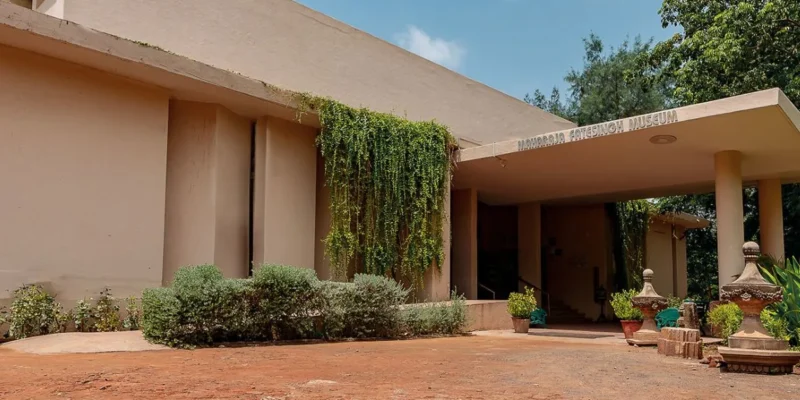
The setting reinforces the experience. The museum is housed in The Retreat, the Sarabhai family’s historic garden estate in Shahibaug. The formal garden, water features, and the architectural character of the haveli complex are themselves worth attention. The trees that surround the museum are functionally important they protect the textiles inside from air pollution and temperature fluctuation but they also make the approach and the between-gallery transitions unexpectedly pleasant. This is a museum in a garden. The combination is rare and beautiful.
The bookshop at the Calico Museum is one of Ahmedabad’s finest specialist retail spaces for publications on Indian art, textiles, and craft. Even if your visit budget is limited, leaving time to browse and purchase from the bookshop publications, photographs, reproductions of museum pieces, postcards is a meaningful extension of the museum experience.
Best Time to Visit Calico Museum of Textiles
October to March — Most Comfortable Season
The winter months are the most comfortable for a Calico Museum visit. The museum and its garden are in Shahibaug, which is pleasant in the cool winter air. The garden part of the Sarabhai estate is at its most attractive in this period. October to March is also peak tourism season in Ahmedabad, which means tour slots may fill more quickly; register even further in advance during this period.
Any Time — The Collection Is Year-Round
Unlike outdoor heritage sites that are weather-dependent, the Calico Museum is an indoor collection that can be visited year-round. The extreme summer heat of Ahmedabad (April to June) makes travel in the city less comfortable, but the museum’s interior is controlled and pleasant regardless of season. Summer visits may actually have more available tour slots as tourist numbers decrease.
Also Read: Famous Food in Ahmedabad
How to Reach Calico Museum of Textiles
| From | Distance | Mode | Approx. Time |
| Shahibaug Bus Stand (local) | Walking distance | Walking | 5 minutes |
| Kalupur Railway Station | ~3–4 km | Auto-rickshaw / Taxi | 15 minutes |
| Ahmedabad city centre (Lal Darwaja) | ~4 km | Auto-rickshaw / Cab | 15 minutes |
| Sabarmati Ashram | ~4 km | Auto / Cab | 15 minutes |
| Sardar Patel National Memorial (Shahibaug) | ~1.4 km | Walking / Auto | 5 minutes |
| SVP International Airport | ~13 km | Taxi | 25–30 minutes |
| Sidi Saiyyed Mosque | ~5 km | Auto / Cab | 20 minutes |
The museum is in Shahibaug, opposite the Underbridge navigate to ‘Calico Museum of Textiles, Shahibaug’ on Google Maps. From Kalupur Railway Station, a direct auto-rickshaw to the museum takes approximately 15 minutes. The Sardar Patel National Memorial (Motibagh Palace) is approximately 1.4 km away and can be visited on the same Shahibaug day.
Nearby Attractions to Combine with Calico Museum
- Sabarmati Ashram ~4 km | Gandhi’s home from 1917 to 1930 the launch point of the 1930 Dandi March. Free entry. Read our full TravelRoach guide.
- Sidi Saiyyed Mosque ~5 km | The famous Tree of Life jali one of the finest examples of carved stone latticework in India; the IIM Ahmedabad logo. Read our full TravelRoach guide.
- Auto World Vintage Car Museum, Kathwada ~20 km | The Guinness-record private car museum with 204 vintage vehicles. Read our full TravelRoach guide.
- Manek Chowk Night Market ~5 km | Ahmedabad’s famed evening street food market in the old city. The textile museum’s intellectual day and the street food market’s sensory evening make a perfect pairing. Read our full TravelRoach guide.
Practical Tips for Visiting Calico Museum of Textiles
- Register in advance – do not wait until arrival day; contact tourregistration@calicomuseum.org or phone +91-79-22868172 at least several days before your visit. Popular dates fill quickly.
- Leave your phone and camera at the hotel – phones and cameras are not permitted inside; they will need to be left at the entrance. Save yourself the inconvenience of carrying them only to leave them outside.
- Do not bring bags inside – bags are also not permitted. Keep what you need in pockets. If carrying a large bag, it will need to be left at the entrance storage.
- Arrive 10 minutes before your tour – the guided tour starts on time; late arrivals disrupt the experience for the other 19 people in the group.
- Allow 3 to 3.5 hours – the morning tour runs from 10:30 AM to 1:45 PM; the full experience including the garden portion is worth the complete time allocation.
- Visit the bookshop at the end – the specialist publications and reproductions at the Calico bookshop are among the finest textile-related retail in Ahmedabad; budget time and money for a browse.
- The afternoon Garden Tour (3:00–5:00 PM) focuses on the estate and garden – consider whether the morning comprehensive collection tour or the afternoon garden-focused tour better suits your interests.
Frequently Asked Questions (FAQs)
The Calico Museum of Textiles in Ahmedabad is the premier textile museum of India and one of the most celebrated of its kind in the world. It holds a collection of Indian textiles spanning five centuries from the 15th to the 19th century including Patan Patola silks (double ikat technique), Mughal court textiles and carpets, the kinkhab tent of Shah Jahan (described as the collection’s piece-de-resistance), Kashmiri shawls, export textiles recovered from Egypt and Bali and produced for the Portuguese and British markets, Vallabha Sampradaya religious textiles and pichhwais, Chamba Rumal embroideries, and royal court costumes from various princely states. It was founded in 1949 by Gautam Sarabhai and Gira Sarabhai and inaugurated by PM Jawaharlal Nehru.
Yes – pre-registration is mandatory for all visitors to the Calico Museum of Textiles. You cannot arrive without prior registration. To register, contact the museum by phone at +91-79-22868172 or +91-79-22865995 (between 10:30 AM and 1:45 PM and between 2:45 PM and 6:00 PM on open days), or by email at tourregistration@calicomuseum.org. Registration requires the full name, phone number, email address, residential address, and profession of every visitor in your group. Tours are capped at 20 people maximum and popular dates book up quickly, particularly during the October to March tourist season.
No – photography and videography are strictly prohibited inside the Calico Museum of Textiles. Cameras and mobile phones are not permitted inside the museum galleries. Handbags are also not allowed inside. These rules exist specifically to protect the fragile textile collection: even phone camera flash accelerates the degradation of centuries-old natural dyes. All items must be left at the entrance or at a storage point before entering the galleries. The museum does sell high-quality photographic reproductions and prints of selected pieces at its bookshop, which is open to visitors after the tour.
The kinkhab tent of Shah Jahan is described as the piece-de-resistance of the Calico Museum’s entire collection. Kinkhab is a silk-and-gold-thread brocade fabric of extraordinary technical complexity, in which gold and silver zari threads are woven with silk to create a surface of such density and lustre that it appears almost solid gold. Shah Jahan who built the Taj Mahal and was the Mughal emperor from 1628 to 1658 served as the Governor of Gujarat before his imperial accession, and the tent dates from this period. A Mughal imperial tent was a portable palace the emperor’s court transported in fabric across the empire. The kinkhab tent panels at Calico represent the highest level of Mughal imperial textile production at its apex.
Patan Patola silks are woven in the city of Patan, Gujarat, using the double ikat technique a process in which both the warp threads (running lengthwise) and the weft threads (running crosswise) are individually tie-dyed in precise patterns before weaving begins. The final pattern appears only when the dyed threads are woven together, requiring extraordinary mathematical precision in the pre-dyeing and consummate weaving skill to ensure the pattern aligns at every thread intersection. The result is fabric of extraordinary visual complexity and technical difficulty. Patola is considered by many textile scholars to represent the zenith of the Indian weaving tradition. The Calico Museum’s collection of Patola pieces is among the finest in the world.
The Calico Museum of Textiles runs guided tours on two schedules: the morning tour from 10:30 AM to 1:45 PM, and the afternoon Garden Tour from 3:00 PM to 5:00 PM. The museum is closed on Mondays and Bank Holidays. Entry fee is free the guided tours are complimentary. However, pre-registration is mandatory; there is no walk-in access. Phone the museum between 10:30 AM and 1:45 PM or 2:45 PM and 6:00 PM (on open days) at +91-79-22868172, or email tourregistration@calicomuseum.org to secure your booking.
The Calico Museum of Textiles was founded in 1949 by the industrialist Gautam Sarabhai and his sister Gira Sarabhai, who owned the Calico Mills in Ahmedabad. The museum was inspired by Dr. Ananda Coomaraswamy the Ceylon-born philosopher and pioneering historian of Indian art who first introduced Indian cultural traditions to the Western academic world. In conversations with Gautam Sarabhai during the 1940s, Coomaraswamy suggested establishing a textile institute in Ahmedabad then India’s textile capital to preserve and study the extraordinary heritage of Indian handicraft textiles at a critical moment when industrialisation threatened to displace traditional knowledge and production.
Final Thoughts
Jawaharlal Nehru said, at the inauguration in 1949, that history might well be written with textiles as its leading motif. He was right. Every major civilisational encounter that shaped India’s history has a textile dimension: the Silk Road commerce, the Mughal imperial court’s patronage, the Gujarat-Southeast Asia trade in which Patola silks were used as diplomatic gifts, the British East India Company’s transformation of Indian cloth from the world’s most desired luxury good into a commodity to be undercut by Lancashire mills.
The Calico Museum of Textiles tells all of these stories through the objects themselves the kinkhab tent panel, the Patola silk, the chintz made for the Portuguese market, the Chamba Rumal embroidered for a gift occasion long forgotten. The objects are the argument. They are extraordinary in every register historically, aesthetically, technically and the museum has protected and displayed them for 75 years with a seriousness of purpose that is evident in every detail of the visiting experience.
Leave your phone at the hotel. Register in advance. Arrive on time. Listen to the guide. This is one of the finest museum visits available anywhere in India.